

GRU)
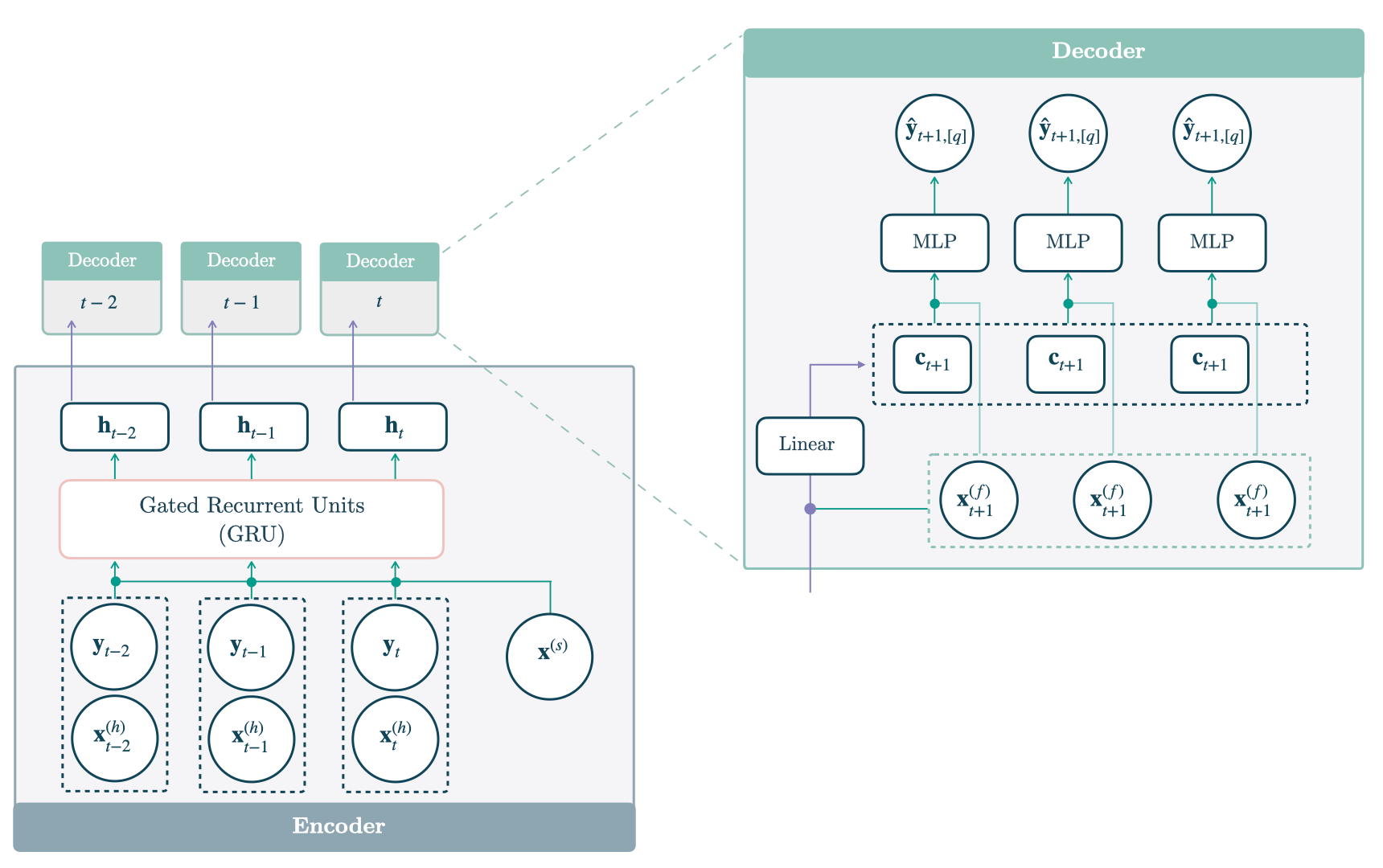
to improve on LSTM and Elman cells. The predictions at each time are
given by a MLP decoder. This architecture follows closely the original
Multi Layer Elman
RNN
with the main difference being its use of the GRU cells. The predictions
are obtained by transforming the hidden states into contexts
, that are decoded and adapted into
through MLPs.
where , is the hidden state for time ,
is the input at time and is the
hidden state of the previous layer at , are
static exogenous inputs, historic exogenous,
are future exogenous available at the time
of the prediction.
References
- Junyoung Chung, Caglar Gulcehre, KyungHyun Cho, Yoshua Bengio (2014). “Empirical Evaluation of Gated Recurrent Neural Networks on Sequence Modeling”.
- Kyunghyun Cho, Bart van Merrienboer, Dzmitry Bahdanau, Yoshua Bengio (2014). “On the Properties of Neural Machine Translation: Encoder-Decoder Approaches”.
GRU
GRU
BaseModel
GRU
Multi Layer Recurrent Network with Gated Units (GRU), and
MLP decoder. The network has non-linear activation functions, it is trained
using ADAM stochastic gradient descent. The network accepts static, historic
and future exogenous data, flattens the inputs.
Parameters:
GRU.fit
fit method, optimizes the neural network’s weights using the
initialization parameters (learning_rate, windows_batch_size, …)
and the loss function as defined during the initialization.
Within fit we use a PyTorch Lightning Trainer that
inherits the initialization’s self.trainer_kwargs, to customize
its inputs, see PL’s trainer arguments.
The method is designed to be compatible with SKLearn-like classes
and in particular to be compatible with the StatsForecast library.
By default the model is not saving training checkpoints to protect
disk memory, to get them change enable_checkpointing=True in __init__.
Parameters:
Returns:
GRU.predict
Trainer execution of predict_step.
Parameters:
Returns: