

The FEDformer model tackles the challenge of finding reliable dependencies on intricate temporal patterns of long-horizon forecasting. The architecture has the following distinctive features:
  • In-built progressive decomposition in trend and seasonal components based on a moving average filter.
  • Frequency Enhanced Block and Frequency Enhanced Attention to perform attention in the sparse representation on basis such as Fourier transform.
  • Classic encoder-decoder proposed by Vaswani et al. (2017) with a multi-head attention mechanism.
The FEDformer model utilizes a three-component approach to define its embedding:
  • It employs encoded autoregressive features obtained from a convolution network.
  • Absolute positional embeddings obtained from calendar features are utilized.
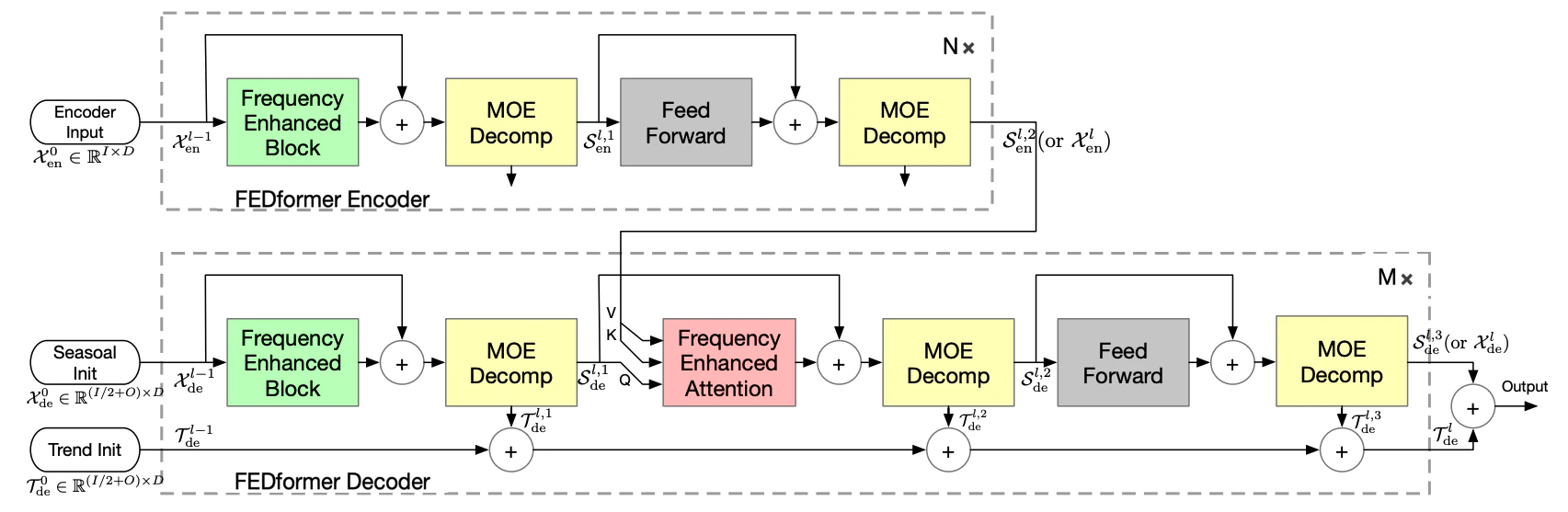
References Figure 1. FEDformer Architecture. Figure 1. FEDformer Architecture.

1. FEDformer

FEDformer

Bases: BaseModel FEDformer The FEDformer model tackles the challenge of finding reliable dependencies on intricate temporal patterns of long-horizon forecasting. The architecture has the following distinctive features:
  • In-built progressive decomposition in trend and seasonal components based on a moving average filter.
  • Frequency Enhanced Block and Frequency Enhanced Attention to perform attention in the sparse representation on basis such as Fourier transform.
  • Classic encoder-decoder proposed by Vaswani et al. (2017) with a multi-head attention mechanism.
The FEDformer model utilizes a three-component approach to define its embedding:
  • It employs encoded autoregressive features obtained from a convolution network.
  • Absolute positional embeddings obtained from calendar features are utilized.
Parameters:
NameTypeDescriptionDefault
hintforecast horizon.required
input_sizeintmaximum sequence length for truncated train backpropagation.required
stat_exog_listList[str]static exogenous columns.None
hist_exog_listList[str]historic exogenous columns.None
futr_exog_listList[str]future exogenous columns.None
decoder_input_size_multiplierfloatmultiplier for the input size of the decoder.0.5
versionstrversion of the model.‘Fourier’
modesintnumber of modes for the Fourier block.64
mode_selectstrmethod to select the modes for the Fourier block.‘random’
hidden_sizeintunits of embeddings and encoders.128
dropoutfloatdropout throughout Autoformer architecture.0.05
n_headintcontrols number of multi-head’s attention.8
conv_hidden_sizeintchannels of the convolutional encoder.32
activationstractivation from [‘ReLU’, ‘Softplus’, ‘Tanh’, ‘SELU’, ‘LeakyReLU’, ‘PReLU’, ‘Sigmoid’, ‘GELU’].‘gelu’
encoder_layersintnumber of layers for the TCN encoder.2
decoder_layersintnumber of layers for the MLP decoder.1
MovingAvg_windowintwindow size for the moving average filter.25
lossPyTorch moduleinstantiated train loss class from losses collection.MAE()
valid_lossPyTorch moduleinstantiated validation loss class from losses collection.None
max_stepsintmaximum number of training steps.5000
learning_ratefloatLearning rate between (0, 1).0.0001
num_lr_decaysintNumber of learning rate decays, evenly distributed across max_steps.-1
early_stop_patience_stepsintNumber of validation iterations before early stopping.-1
val_check_stepsintNumber of training steps between every validation loss check.100
batch_sizeintnumber of different series in each batch.32
valid_batch_sizeintnumber of different series in each validation and test batch, if None uses batch_size.None
windows_batch_sizeintnumber of windows to sample in each training batch, default uses all.1024
inference_windows_batch_sizeintnumber of windows to sample in each inference batch.1024
start_padding_enabledboolif True, the model will pad the time series with zeros at the beginning, by input size.False
training_data_availability_thresholdUnion[float, List[float]]minimum fraction of valid data points required for training windows. Single float applies to both insample and outsample; list of two floats specifies [insample_fraction, outsample_fraction]. Default 0.0 allows windows with only 1 valid data point (current behavior).0.0
step_sizeintstep size between each window of temporal data.1
scaler_typestrtype of scaler for temporal inputs normalization see temporal scalers.‘identity’
random_seedintrandom_seed for pytorch initializer and numpy generators.1
drop_last_loaderboolif True TimeSeriesDataLoader drops last non-full batch.False
aliasstroptional, Custom name of the model.None
optimizerSubclass of ‘torch.optim.Optimizer’optional, user specified optimizer instead of the default choice (Adam).None
optimizer_kwargsdictoptional, list of parameters used by the user specified optimizer.None
lr_schedulerSubclass of ‘torch.optim.lr_scheduler.LRScheduler’optional, user specified lr_scheduler instead of the default choice (StepLR).None
lr_scheduler_kwargsdictoptional, list of parameters used by the user specified lr_scheduler.None
dataloader_kwargsdictoptional, list of parameters passed into the PyTorch Lightning dataloader by the TimeSeriesDataLoader.None
**trainer_kwargsintkeyword trainer arguments inherited from PyTorch Lighning’s trainer.

FEDformer.fit

Fit. The fit method, optimizes the neural network’s weights using the initialization parameters (learning_rate, windows_batch_size, …) and the loss function as defined during the initialization. Within fit we use a PyTorch Lightning Trainer that inherits the initialization’s self.trainer_kwargs, to customize its inputs, see PL’s trainer arguments. The method is designed to be compatible with SKLearn-like classes and in particular to be compatible with the StatsForecast library. By default the model is not saving training checkpoints to protect disk memory, to get them change enable_checkpointing=True in __init__. Parameters:
NameTypeDescriptionDefault
datasetTimeSeriesDatasetNeuralForecast’s TimeSeriesDataset, see documentation.required
val_sizeintValidation size for temporal cross-validation.0
random_seedintRandom seed for pytorch initializer and numpy generators, overwrites model.init’s.None
test_sizeintTest size for temporal cross-validation.0
Returns:
TypeDescription
None

FEDformer.predict

Predict. Neural network prediction with PL’s Trainer execution of predict_step. Parameters:
NameTypeDescriptionDefault
datasetTimeSeriesDatasetNeuralForecast’s TimeSeriesDataset, see documentation.required
test_sizeintTest size for temporal cross-validation.None
step_sizeintStep size between each window.1
random_seedintRandom seed for pytorch initializer and numpy generators, overwrites model.init’s.None
quantileslistTarget quantiles to predict.None
hintPrediction horizon, if None, uses the model’s fitted horizon. Defaults to None.None
explainer_configdictconfiguration for explanations.None
**data_module_kwargsdictPL’s TimeSeriesDataModule args, see documentation.
Returns:
TypeDescription
None

Usage Example

2. Auxiliary functions

AutoCorrelationLayer

Bases: Module Auto Correlation Layer

LayerNorm

Bases: Module Special designed layernorm for the seasonal part

Decoder

Bases: Module FEDformer decoder

DecoderLayer

Bases: Module FEDformer decoder layer with the progressive decomposition architecture

Encoder

Bases: Module FEDformer encoder

EncoderLayer

Bases: Module FEDformer encoder layer with the progressive decomposition architecture

FourierCrossAttention

Bases: Module Fourier Cross Attention layer

FourierBlock

Bases: Module Fourier block

FourierBlock.compl_mul1d

FourierBlock.forward

FourierBlock.index

FourierBlock.scale

FourierBlock.weights1

get_frequency_modes