

The Dilated Recurrent Neural Network (Documentation Index
Fetch the complete documentation index at: https://nixtla-feat-posthog-analytics.mintlify.app/llms.txt
Use this file to discover all available pages before exploring further.
DilatedRNN)
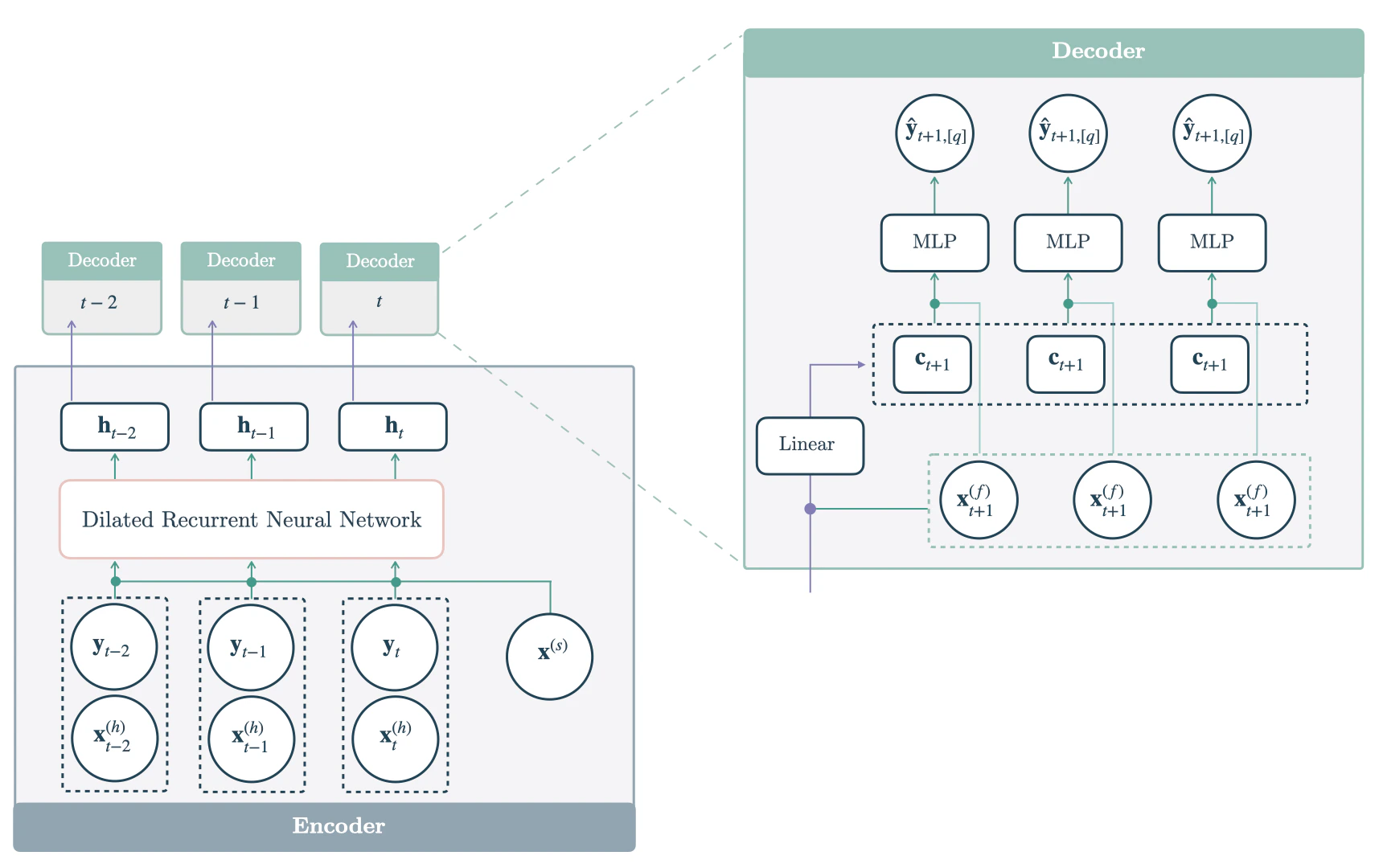
addresses common challenges of modeling long sequences like vanishing
gradients, computational efficiency, and improved model flexibility to
model complex relationships while maintaining its parsimony. The
DilatedRNN
builds a deep stack of RNN layers using skip conditions on the temporal
and the network’s depth dimensions. The temporal dilated recurrent skip
connections offer the capability to focus on multi-resolution inputs.The
predictions are obtained by transforming the hidden states into contexts
, that are decoded and adapted into
through MLPs.
where , is the hidden state for time ,
is the input at time and is the
hidden state of the previous layer at , are
static exogenous inputs, historic exogenous,
are future exogenous available at the time
of the prediction.
References
- Shiyu Chang, et al. “Dilated Recurrent Neural Networks”.
- Yao Qin, et al. “A Dual-Stage Attention-Based recurrent neural network for time series prediction”.
- Kashif Rasul, et al. “Zalando Research: PyTorch Dilated Recurrent Neural Networks”.
Dilated RNN
DilatedRNN
BaseModel
DilatedRNN
Parameters:
| Name | Type | Description | Default |
|---|---|---|---|
h | int | forecast horizon. | required |
input_size | int | maximum sequence length for truncated train backpropagation. Default -1 uses 3 * horizon | -1 |
inference_input_size | int | maximum sequence length for truncated inference. Default None uses input_size history. | None |
cell_type | str | type of RNN cell to use. Options: ‘GRU’, ‘RNN’, ‘LSTM’, ‘ResLSTM’, ‘AttentiveLSTM’. | ‘LSTM’ |
dilations | int list | dilations betweem layers. | [[1, 2], [4, 8]] |
encoder_hidden_size | int | units for the RNN’s hidden state size. | 128 |
context_size | int | size of context vector for each timestamp on the forecasting window. | 10 |
decoder_hidden_size | int | size of hidden layer for the MLP decoder. | 128 |
decoder_layers | int | number of layers for the MLP decoder. | 2 |
futr_exog_list | str list | future exogenous columns. | None |
hist_exog_list | str list | historic exogenous columns. | None |
stat_exog_list | str list | static exogenous columns. | None |
exclude_insample_y | bool | the model skips the autoregressive features y[t-input_size:t] if True. | False |
loss | PyTorch module | instantiated train loss class from losses collection. | MAE() |
valid_loss | PyTorch module | instantiated valid loss class from losses collection. | None |
max_steps | int | maximum number of training steps. | 1000 |
learning_rate | float | Learning rate between (0, 1). | 0.001 |
num_lr_decays | int | Number of learning rate decays, evenly distributed across max_steps. | 3 |
early_stop_patience_steps | int | Number of validation iterations before early stopping. | -1 |
val_check_steps | int | Number of training steps between every validation loss check. | 100 |
batch_size | int | number of different series in each batch. | 32 |
valid_batch_size | int | number of different series in each validation and test batch. | None |
windows_batch_size | int | number of windows to sample in each training batch, default uses all. | 128 |
inference_windows_batch_size | int | number of windows to sample in each inference batch, -1 uses all. | 1024 |
start_padding_enabled | bool | if True, the model will pad the time series with zeros at the beginning, by input size. | False |
training_data_availability_threshold | Union[float, List[float]] | minimum fraction of valid data points required for training windows. Single float applies to both insample and outsample; list of two floats specifies [insample_fraction, outsample_fraction]. Default 0.0 allows windows with only 1 valid data point (current behavior). | 0.0 |
step_size | int | step size between each window of temporal data. | 1 |
scaler_type | str | type of scaler for temporal inputs normalization see temporal scalers. | ‘robust’ |
random_seed | int | random_seed for pytorch initializer and numpy generators. | 1 |
drop_last_loader | bool | if True TimeSeriesDataLoader drops last non-full batch. | False |
alias | str | optional, Custom name of the model. | None |
optimizer | Subclass of ‘torch.optim.Optimizer’ | optional, user specified optimizer instead of the default choice (Adam). | None |
optimizer_kwargs | dict | optional, list of parameters used by the user specified optimizer. | None |
lr_scheduler | Subclass of ‘torch.optim.lr_scheduler.LRScheduler’ | optional, user specified lr_scheduler instead of the default choice (StepLR). | None |
lr_scheduler_kwargs | dict | optional, list of parameters used by the user specified lr_scheduler. | None |
dataloader_kwargs | dict | optional, list of parameters passed into the PyTorch Lightning dataloader by the TimeSeriesDataLoader. | None |
**trainer_kwargs | int | keyword trainer arguments inherited from PyTorch Lighning’s trainer. |
DilatedRNN.fit
fit method, optimizes the neural network’s weights using the
initialization parameters (learning_rate, windows_batch_size, …)
and the loss function as defined during the initialization.
Within fit we use a PyTorch Lightning Trainer that
inherits the initialization’s self.trainer_kwargs, to customize
its inputs, see PL’s trainer arguments.
The method is designed to be compatible with SKLearn-like classes
and in particular to be compatible with the StatsForecast library.
By default the model is not saving training checkpoints to protect
disk memory, to get them change enable_checkpointing=True in __init__.
Parameters:
| Name | Type | Description | Default |
|---|---|---|---|
dataset | TimeSeriesDataset | NeuralForecast’s TimeSeriesDataset, see documentation. | required |
val_size | int | Validation size for temporal cross-validation. | 0 |
random_seed | int | Random seed for pytorch initializer and numpy generators, overwrites model.init’s. | None |
test_size | int | Test size for temporal cross-validation. | 0 |
| Type | Description |
|---|---|
| None |
DilatedRNN.predict
Trainer execution of predict_step.
Parameters:
| Name | Type | Description | Default |
|---|---|---|---|
dataset | TimeSeriesDataset | NeuralForecast’s TimeSeriesDataset, see documentation. | required |
test_size | int | Test size for temporal cross-validation. | None |
step_size | int | Step size between each window. | 1 |
random_seed | int | Random seed for pytorch initializer and numpy generators, overwrites model.init’s. | None |
quantiles | list | Target quantiles to predict. | None |
h | int | Prediction horizon, if None, uses the model’s fitted horizon. Defaults to None. | None |
explainer_config | dict | configuration for explanations. | None |
**data_module_kwargs | dict | PL’s TimeSeriesDataModule args, see documentation. |
| Type | Description |
|---|---|
| None |

