

The
BaseAuto class offers shared API connections to hyperparameter optimization
algorithms like
Optuna,
HyperOpt,
Dragonfly
among others through ray, which gives you access to grid search, bayesian
optimization and other state-of-the-art tools like
hyperband.
Comprehending the impacts of hyperparameters is still a
precious skill, as it can help guide the design of informed hyperparameter
spaces that are faster to explore automatically.
BaseAuto
LightningModule
Class for Automatic Hyperparameter Optimization, it builds on top of ray to
give access to a wide variety of hyperparameter optimization tools ranging
from classic grid search, to Bayesian optimization and HyperBand algorithm.
The validation loss to be optimized is defined by the config['loss'] dictionary
value, the config also contains the rest of the hyperparameter search space.
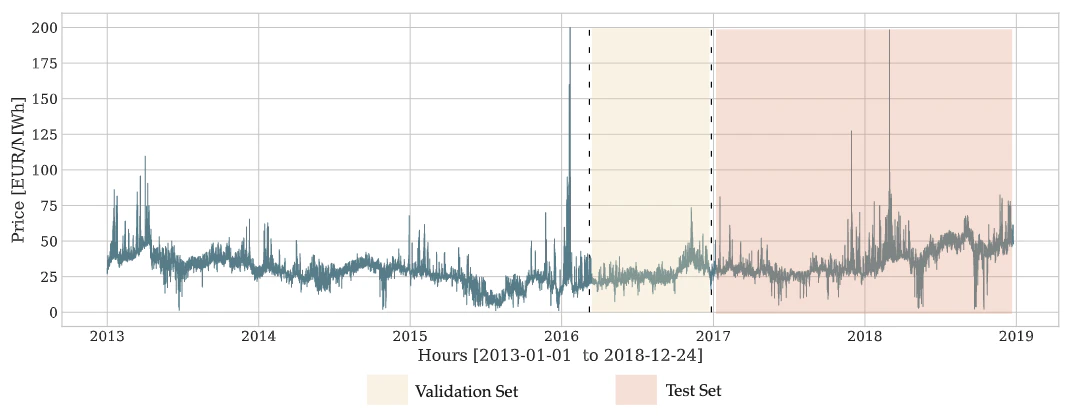
It is important to note that the success of this hyperparameter optimization
heavily relies on a strong correlation between the validation and test periods.
Parameters:
BaseAuto.fit
config.
The optimization is performed on the TimeSeriesDataset using temporal cross validation with
the validation set that sequentially precedes the test set.
Parameters:
Returns:
BaseAuto.predict
Returns:
Usage Example
References
- James Bergstra, Remi Bardenet, Yoshua Bengio, and Balazs Kegl (2011). “Algorithms for Hyper-Parameter Optimization”. In: Advances in Neural Information Processing Systems. url: https://proceedings.neurips.cc/paper/2011/file/86e8f7ab32cfd12577bc2619bc635690-Paper.pdf
- Kirthevasan Kandasamy, Karun Raju Vysyaraju, Willie Neiswanger, Biswajit Paria, Christopher R. Collins, Jeff Schneider, Barnabas Poczos, Eric P. Xing (2019). “Tuning Hyperparameters without Grad Students: Scalable and Robust Bayesian Optimisation with Dragonfly”. Journal of Machine Learning Research. url: https://arxiv.org/abs/1903.06694
- Lisha Li, Kevin Jamieson, Giulia DeSalvo, Afshin Rostamizadeh, Ameet Talwalkar (2016). “Hyperband: A Novel Bandit-Based Approach to Hyperparameter Optimization”. Journal of Machine Learning Research. url: https://arxiv.org/abs/1603.06560