> ## Documentation Index
> Fetch the complete documentation index at: https://nixtla-feat-posthog-analytics.mintlify.site/llms.txt
> Use this file to discover all available pages before exploring further.
> TimeMixer: Temporal mixing architecture for multivariate time series forecasting with multi-scale decomposition and frequency-domain feature extraction.
# TimeMixer
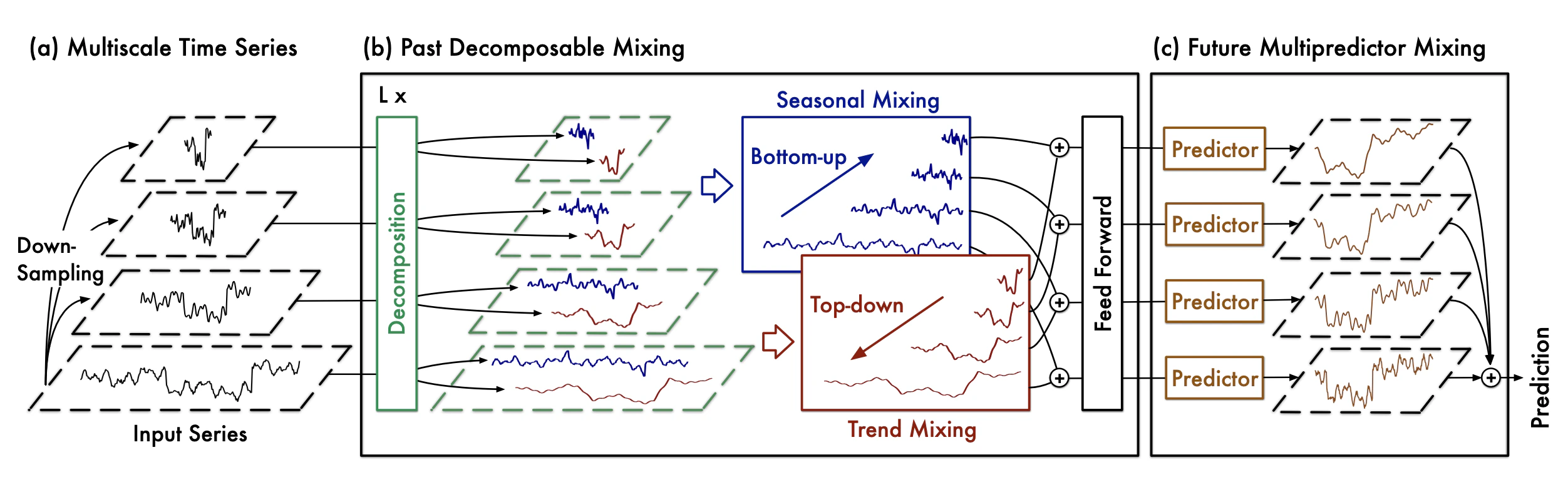 *Figure 1. Architecture of SOFTS.*
## 1. TimeMixer
### `TimeMixer`
```python theme={null}
TimeMixer(
h,
input_size,
n_series,
stat_exog_list=None,
hist_exog_list=None,
futr_exog_list=None,
d_model=32,
d_ff=32,
dropout=0.1,
e_layers=4,
top_k=5,
decomp_method="moving_avg",
moving_avg=25,
channel_independence=0,
down_sampling_layers=1,
down_sampling_window=2,
down_sampling_method="avg",
use_norm=True,
decoder_input_size_multiplier=0.5,
loss=MAE(),
valid_loss=None,
max_steps=1000,
learning_rate=0.001,
num_lr_decays=-1,
early_stop_patience_steps=-1,
val_check_steps=100,
batch_size=32,
valid_batch_size=None,
windows_batch_size=32,
inference_windows_batch_size=32,
start_padding_enabled=False,
training_data_availability_threshold=0.0,
step_size=1,
scaler_type="identity",
random_seed=1,
drop_last_loader=False,
alias=None,
optimizer=None,
optimizer_kwargs=None,
lr_scheduler=None,
lr_scheduler_kwargs=None,
dataloader_kwargs=None,
**trainer_kwargs
)
```
Bases:
*Figure 1. Architecture of SOFTS.*
## 1. TimeMixer
### `TimeMixer`
```python theme={null}
TimeMixer(
h,
input_size,
n_series,
stat_exog_list=None,
hist_exog_list=None,
futr_exog_list=None,
d_model=32,
d_ff=32,
dropout=0.1,
e_layers=4,
top_k=5,
decomp_method="moving_avg",
moving_avg=25,
channel_independence=0,
down_sampling_layers=1,
down_sampling_window=2,
down_sampling_method="avg",
use_norm=True,
decoder_input_size_multiplier=0.5,
loss=MAE(),
valid_loss=None,
max_steps=1000,
learning_rate=0.001,
num_lr_decays=-1,
early_stop_patience_steps=-1,
val_check_steps=100,
batch_size=32,
valid_batch_size=None,
windows_batch_size=32,
inference_windows_batch_size=32,
start_padding_enabled=False,
training_data_availability_threshold=0.0,
step_size=1,
scaler_type="identity",
random_seed=1,
drop_last_loader=False,
alias=None,
optimizer=None,
optimizer_kwargs=None,
lr_scheduler=None,
lr_scheduler_kwargs=None,
dataloader_kwargs=None,
**trainer_kwargs
)
```
Bases: [BaseModel](#neuralforecast.common._base_model.BaseModel)
TimeMixer
Args:
h (int): Forecast horizon.
input\_size (int): autorregresive inputs size, y=\[1,2,3,4] input\_size=2 -> y\_\[t-2:t]=\[1,2].
n\_series (int): number of time-series.
stat\_exog\_list (list): static exogenous columns.
hist\_exog\_list (list): historic exogenous columns.
futr\_exog\_list (list): future exogenous columns.
d\_model (int): dimension of the model.
d\_ff (int): dimension of the fully-connected network.
dropout (float): dropout rate.
e\_layers (int): number of encoder layers.
top\_k (int): number of selected frequencies.
decomp\_method (str): method of series decomposition \[moving\_avg, dft\_decomp].
moving\_avg (int): window size of moving average.
channel\_independence (int): 0: channel dependence, 1: channel independence.
down\_sampling\_layers (int): number of downsampling layers.
down\_sampling\_window (int): size of downsampling window.
down\_sampling\_method (str): down sampling method \[avg, max, conv].
use\_norm (bool): whether to normalize or not.
decoder\_input\_size\_multiplier (float): 0.5.
loss (PyTorch module): instantiated train loss class from [losses collection](./losses.pytorch).
valid\_loss (PyTorch module): instantiated valid loss class from [losses collection](./losses.pytorch).
max\_steps (int): maximum number of training steps.
learning\_rate (float): Learning rate between (0, 1).
num\_lr\_decays (int): Number of learning rate decays, evenly distributed across max\_steps.
early\_stop\_patience\_steps (int): Number of validation iterations before early stopping.
val\_check\_steps (int): Number of training steps between every validation loss check.
batch\_size (int): number of different series in each batch.
valid\_batch\_size (int): number of different series in each validation and test batch, if None uses batch\_size.
windows\_batch\_size (int): number of windows to sample in each training batch, default uses all.
inference\_windows\_batch\_size (int): number of windows to sample in each inference batch, -1 uses all.
start\_padding\_enabled (bool): if True, the model will pad the time series with zeros at the beginning, by input size.
training\_data\_availability\_threshold (Union\[float, List\[float]]): minimum fraction of valid data points required for training windows. Single float applies to both insample and outsample; list of two floats specifies \[insample\_fraction, outsample\_fraction]. Default 0.0 allows windows with only 1 valid data point (current behavior).
step\_size (int): step size between each window of temporal data.
scaler\_type (str): type of scaler for temporal inputs normalization see [temporal scalers](https://github.com/Nixtla/neuralforecast/blob/main/neuralforecast/common/_scalers.py).
random\_seed (int): random\_seed for pytorch initializer and numpy generators.
drop\_last\_loader (bool): if True `TimeSeriesDataLoader` drops last non-full batch.
alias (str): optional, Custom name of the model.
optimizer (Subclass of 'torch.optim.Optimizer'): optional, user specified optimizer instead of the default choice (Adam).
optimizer\_kwargs (dict): optional, list of parameters used by the user specified `optimizer`.
lr\_scheduler (Subclass of 'torch.optim.lr\_scheduler.LRScheduler'): optional, user specified lr\_scheduler instead of the default choice (StepLR).
lr\_scheduler\_kwargs (dict): optional, list of parameters used by the user specified `lr_scheduler`.
dataloader\_kwargs (dict): optional, list of parameters passed into the PyTorch Lightning dataloader by the `TimeSeriesDataLoader`.
\*\*trainer\_kwargs (keyword): trainer arguments inherited from [PyTorch Lighning's trainer](https://pytorch-lightning.readthedocs.io/en/stable/api/pytorch_lightning.trainer.trainer.Trainer.html?highlight=trainer).
References
* [Shiyu Wang, Haixu Wu, Xiaoming Shi, Tengge Hu, Huakun Luo, Lintao Ma, James Y. Zhang, Jun Zhou."TimeMixer: Decomposable Multiscale Mixing For Time Series Forecasting"](https://openreview.net/pdf?id=7oLshfEIC2)
#### `TimeMixer.fit`
```python theme={null}
fit(
dataset, val_size=0, test_size=0, random_seed=None, distributed_config=None
)
```
Fit.
The `fit` method, optimizes the neural network's weights using the
initialization parameters (`learning_rate`, `windows_batch_size`, ...)
and the `loss` function as defined during the initialization.
Within `fit` we use a PyTorch Lightning `Trainer` that
inherits the initialization's `self.trainer_kwargs`, to customize
its inputs, see [PL's trainer arguments](https://pytorch-lightning.readthedocs.io/en/stable/api/pytorch_lightning.trainer.trainer.Trainer.html?highlight=trainer).
The method is designed to be compatible with SKLearn-like classes
and in particular to be compatible with the StatsForecast library.
By default the `model` is not saving training checkpoints to protect
disk memory, to get them change `enable_checkpointing=True` in `__init__`.
**Parameters:**
| Name | Type | Description | Default |
| ------------- | ---------------------------------------------------- | -------------------------------------------------------------------------------------- | ----------------- |
| `dataset` | [TimeSeriesDataset](#TimeSeriesDataset) | NeuralForecast's `TimeSeriesDataset`, see [documentation](./tsdataset). | *required* |
| `val_size` | [int](#int) | Validation size for temporal cross-validation. | 0 |
| `random_seed` | [int](#int) | Random seed for pytorch initializer and numpy generators, overwrites model.**init**'s. | None |
| `test_size` | [int](#int) | Test size for temporal cross-validation. | 0 |
**Returns:**
| Type | Description |
| ---- | ----------- |
| None | |
#### `TimeMixer.predict`
```python theme={null}
predict(
dataset,
test_size=None,
step_size=1,
random_seed=None,
quantiles=None,
h=None,
explainer_config=None,
**data_module_kwargs
)
```
Predict.
Neural network prediction with PL's `Trainer` execution of `predict_step`.
**Parameters:**
| Name | Type | Description | Default |
| ---------------------- | ---------------------------------------------------- | ------------------------------------------------------------------------------------------------------------------------------------------------------ | ----------------- |
| `dataset` | [TimeSeriesDataset](#TimeSeriesDataset) | NeuralForecast's `TimeSeriesDataset`, see [documentation](./tsdataset). | *required* |
| `test_size` | [int](#int) | Test size for temporal cross-validation. | None |
| `step_size` | [int](#int) | Step size between each window. | 1 |
| `random_seed` | [int](#int) | Random seed for pytorch initializer and numpy generators, overwrites model.**init**'s. | None |
| `quantiles` | [list](#list) | Target quantiles to predict. | None |
| `h` | [int](#int) | Prediction horizon, if None, uses the model's fitted horizon. Defaults to None. | None |
| `explainer_config` | [dict](#dict) | configuration for explanations. | None |
| `**data_module_kwargs` | [dict](#dict) | PL's TimeSeriesDataModule args, see [documentation](https://pytorch-lightning.readthedocs.io/en/1.6.1/extensions/datamodules.html#using-a-datamodule). | {} |
**Returns:**
| Type | Description |
| ---- | ----------- |
| None | |
### Usage example
```python theme={null}
import pandas as pd
import matplotlib.pyplot as plt
from neuralforecast import NeuralForecast
from neuralforecast.models import TimeMixer
from neuralforecast.utils import AirPassengersPanel, AirPassengersStatic
from neuralforecast.losses.pytorch import MAE
Y_train_df = AirPassengersPanel[AirPassengersPanel.ds=AirPassengersPanel['ds'].values[-12]].reset_index(drop=True) # 12 test
model = TimeMixer(h=12,
input_size=24,
n_series=2,
scaler_type='standard',
max_steps=500,
early_stop_patience_steps=-1,
val_check_steps=5,
learning_rate=1e-3,
loss = MAE(),
valid_loss=MAE(),
batch_size=32
)
fcst = NeuralForecast(models=[model], freq='ME')
fcst.fit(df=Y_train_df, static_df=AirPassengersStatic, val_size=12)
forecasts = fcst.predict(futr_df=Y_test_df)
# Plot predictions
fig, ax = plt.subplots(1, 1, figsize = (20, 7))
Y_hat_df = forecasts.reset_index(drop=False).drop(columns=['unique_id','ds'])
plot_df = pd.concat([Y_test_df, Y_hat_df], axis=1)
plot_df = pd.concat([Y_train_df, plot_df])
plot_df = plot_df[plot_df.unique_id=='Airline1'].drop('unique_id', axis=1)
plt.plot(plot_df['ds'], plot_df['y'], c='black', label='True')
plt.plot(plot_df['ds'], plot_df['TimeMixer'], c='blue', label='median')
ax.set_title('AirPassengers Forecast', fontsize=22)
ax.set_ylabel('Monthly Passengers', fontsize=20)
ax.set_xlabel('Year', fontsize=20)
ax.legend(prop={'size': 15})
ax.grid()
```
Using `cross_validation` to forecast multiple historic values.
```python theme={null}
fcst = NeuralForecast(models=[model], freq='M')
forecasts = fcst.cross_validation(df=AirPassengersPanel, static_df=AirPassengersStatic, n_windows=2, step_size=12)
# Plot predictions
fig, ax = plt.subplots(1, 1, figsize = (20, 7))
Y_hat_df = forecasts.loc['Airline1']
Y_df = AirPassengersPanel[AirPassengersPanel['unique_id']=='Airline1']
plt.plot(Y_df['ds'], Y_df['y'], c='black', label='True')
plt.plot(Y_hat_df['ds'], Y_hat_df['TimeMixer'], c='blue', label='Forecast')
ax.set_title('AirPassengers Forecast', fontsize=22)
ax.set_ylabel('Monthly Passengers', fontsize=20)
ax.set_xlabel('Year', fontsize=20)
ax.legend(prop={'size': 15})
ax.grid()
```
## 2. Auxiliary Functions
### 2.1 Embedding
### `DataEmbedding_wo_pos`
```python theme={null}
DataEmbedding_wo_pos(c_in, d_model, dropout=0.1, embed_type='fixed', freq='h')
```
Bases: [Module](#torch.nn.Module)
DataEmbedding\_wo\_pos
### `DFT_series_decomp`
```python theme={null}
DFT_series_decomp(top_k)
```
Bases: [Module](#torch.nn.Module)
Series decomposition block
### 2.2 Mixing
### `PastDecomposableMixing`
```python theme={null}
PastDecomposableMixing(
seq_len,
pred_len,
down_sampling_window,
down_sampling_layers,
d_model,
dropout,
channel_independence,
decomp_method,
d_ff,
moving_avg,
top_k,
)
```
Bases: [Module](#torch.nn.Module)
PastDecomposableMixing
### `MultiScaleTrendMixing`
```python theme={null}
MultiScaleTrendMixing(seq_len, down_sampling_window, down_sampling_layers)
```
Bases: [Module](#torch.nn.Module)
Top-down mixing trend pattern
### `MultiScaleSeasonMixing`
```python theme={null}
MultiScaleSeasonMixing(seq_len, down_sampling_window, down_sampling_layers)
```
Bases: [Module](#torch.nn.Module)
Bottom-up mixing season pattern